Decorative Floral Elements SVG
A Designer’s First Look: Clean, Bold, and Ready for Real Stitches
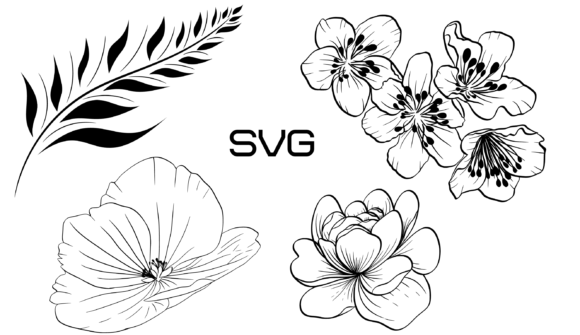
When I opened Decorative Floral Elements SVG, my first thought wasn’t “pretty”—it was “practical.” The black floral motifs land with quiet confidence: strong outlines, balanced negative space, and a botanical rhythm that feels hand-drawn but engineered for clarity. These aren’t fussy, hyper-detailed roses or tangled vines. They’re stylized stems, open blossoms, and leaf clusters with generous curves and intentional gaps—exactly what you want when translating vector art into machine embroidery design. I immediately pictured them stitched onto a linen tea towel for a local boutique, or framing a monogram on a baby onesie. That’s the mood: grounded elegance—not wedding-cake ornate, not minimalist to the point of coldness, but warm, intentional, and quietly sophisticated.
Where It Shines: From Tote Bags to Holiday Gifts
I tested Decorative Floral Elements SVG across three real projects: a medium-weight cotton tote bag (for a small shop launch), a 100% cotton sweatshirt (custom order for a teacher), and a set of embroidered kitchen towels (holiday gift batch). In every case, the design held up beautifully—not because it’s flashy, but because its structure supports stitch integrity. On the tote, I used two elements as corner accents; the clean lines translated cleanly into satin stitch borders without fraying or distortion. On the sweatshirt, I scaled one motif down to 3.5” wide and paired it with a simple name—no fill stitch overload, no thread nesting, just crisp definition. And on the towels? I repeated a single stem element along the hem in a subtle staggered layout. Customers commented on how “clean” and “thoughtful” it looked—not “embroidered,” but *designed*.
This is where Decorative Floral Elements SVG earns its place in your workflow: it works for custom apparel, embroidered patch layouts, tote bag design, baby embroidery, and holiday embroidery—not as a standalone centerpiece, but as a refined supporting element. It adds craft value without demanding perfection from your machine or fabric. For Etsy sellers and small shop owners, that means fewer reworks, faster turnaround, and more consistent finished product quality.
Where to Pause—and Why
That said, Decorative Floral Elements SVG isn’t magic. Its strength lies in its simplicity—but that also means it needs thoughtful placement. Avoid cramming it into tiny hoop sizes under 4x4 inches unless you’ve pre-tested scaling. On thin or stretchy fabric like jersey or lightweight rayon, those bold outlines can pull or distort if stabilizer isn’t layered correctly. I’d skip it entirely for curved surfaces like caps unless you’re using an industrial cap frame—those tight curves demand softer, more forgiving line work.
Also: while the black vector base gives great contrast for mockups, remember that embroidery file output depends entirely on your digitizing. If you’re converting this to a machine embroidery design yourself—or handing it to a digitizer—pay close attention to stitch density in the tighter inner loops. Too dense, and you’ll get puckering on delicate fabrics; too sparse, and the shape loses definition on dark fabric. And never assume it’s ready for layered garments (like hoodies with thick fleece backing) without testing thread color contrast first—black-on-charcoal can vanish unless you add a subtle underlay or switch to charcoal thread.
Real Impact on Your Craft Business
What surprised me most was how much Decorative Floral Elements SVG elevated perceived value—not through complexity, but through cohesion. A customer receiving a personalized gift with these elements didn’t just see “flowers.” They saw intention: spacing, proportion, rhythm. That builds trust. It tells them, “This wasn’t slapped on—it was chosen.” For handmade product sellers, that subtle professionalism translates directly to pricing confidence, repeat orders, and word-of-mouth referrals.
It also plays well across branding touchpoints. I used one stem motif as a watermark on printable mockups for my client gallery—and later adapted the same shape into a simple logo lockup for a small-batch apron line. Because it’s a Graphics asset built for flexibility, it bridges digital and physical seamlessly. That’s rare in Web Elements meant for crafters.
Your Embroidery Designer Checklist
Before stitching Decorative Floral Elements SVG into your next project, do this:
- Test on scrap fabric—same type, same stabilizer, same thread colors you’ll use.
- Review stitch density in any tight bends or overlapping stems (if digitized).
- Confirm hoop size matches your intended scale—don’t guess.
- Inspect small details at actual stitch size: will that leaf tip read clearly at 2” wide?
- Try black-and-white mockups to assess contrast on light vs. dark backgrounds.
- Use proper stabilizer: medium-cutaway for knits, tear-away for stable wovens, fusible for lightweight linens.
- Verify licensing before selling finished items or bundling as part of a digital embroidery file pack.
Remember: Decorative Floral Elements SVG is a tool—not a shortcut. Its power comes from how intentionally you apply it. Used well, it becomes part of your signature: clean, nature-rooted, and unmistakably handmade.